Scout leads on structure
The widest margins are on multi-step tasks: repair lookahead (70 against a next best of 51.7) and the BTC strategy build (81.7 against 55 for Claude Code and Codex).

ScoutBench results
ScoutBench scores AI coding agents on the failures that break trading research. Same model, four harnesses, five tasks, and 20 verifier checks per task. Here are the full results, including where Scout loses.
Mean verifier score from 0 to 100 for each harness on each task. The same model ran inside every harness.
| Task | Scout | Claude Code | Codex | OpenCode |
|---|---|---|---|---|
| Hallucination resistance | 25 | 25 | 28.3 | 21.2 |
| Numeric discipline | 30 | 45 | 30 | 45 |
| Repair lookahead | 70 | 51.7 | 45 | 35 |
| Research memo | 60 | 55 | 62 | 55 |
| BTC strategy | 81.7 | 55 | 55 | 36.7 |
| Mean across tasks | 53.3 | 46.3 | 44.1 | 38.6 |
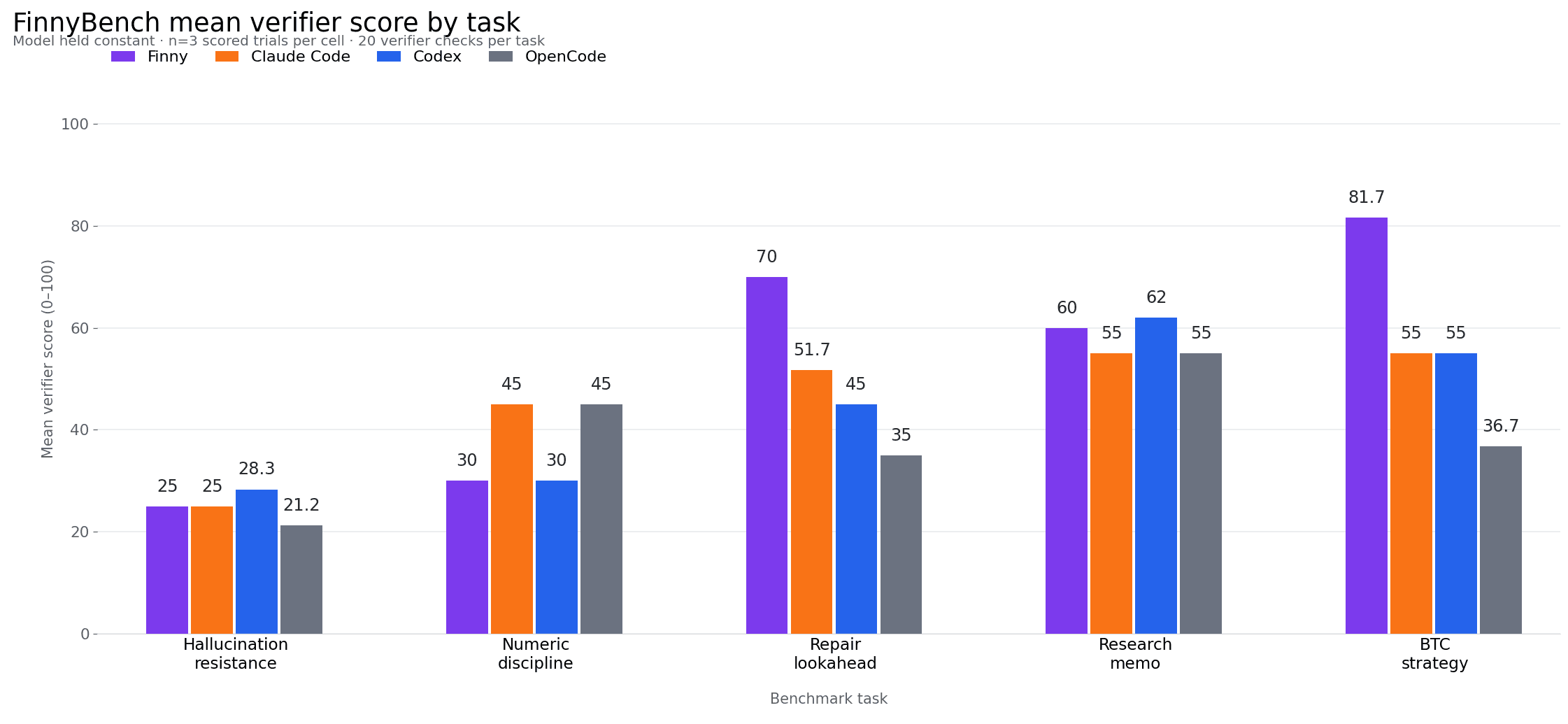
ScoutBench mean verifier score by task. Model held constant, n=3, 20 checks per task.
The widest margins are on multi-step tasks: repair lookahead (70 against a next best of 51.7) and the BTC strategy build (81.7 against 55 for Claude Code and Codex).
On numeric discipline Scout and Codex score 30 while Claude Code and OpenCode reach 45. That gap is a concrete target for the Scout harness.
Codex scores 62 to Scout's 60 on the research memo, which is inside the noise of a three-trial sample.
Hallucination resistance tops out at 28.3 for every harness. Every agent fails roughly three of four checks, which is why generated code must stay inspectable and humans stay in the loop.
Does the agent invent tickers, fields, prices, or API surfaces that do not exist?
Returns, position sizing, percentages versus basis points, and compounding done correctly.
Find and fix a strategy that peeks at future data without breaking the strategy's intent.
Turn a run into a memo whose claims trace back to actual evidence rather than narrative.
Take a crypto strategy idea from description to a working, testable implementation.